
Application-based torque sensors are selected and configured to meet specific torque, speed, accuracy, mounting, mechanical, electrical, and environmental requirements. They are used for specialized torque measurement applications where standard sensors may not provide the required performance, mechanical configuration, or system integration.
These solutions can be selected for specific machinery and testing applications, as well as performance requirements such as high-speed operation, high accuracy, high torque capacity, endurance testing, fatigue testing, and dual-range torque measurement
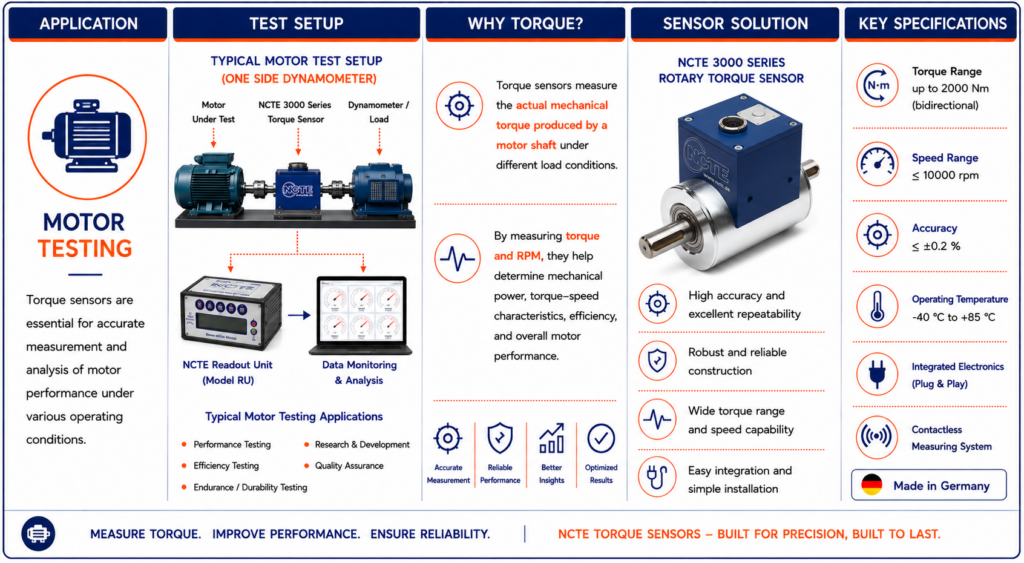
1. Motor Testing
Motor testing is the process of measuring and evaluating the performance, efficiency, reliability, and durability of an electric or hydraulic motor under different operating conditions. A torque sensor installed between the motor under test and the load or dynamometer measures the actual mechanical torque produced by the motor.
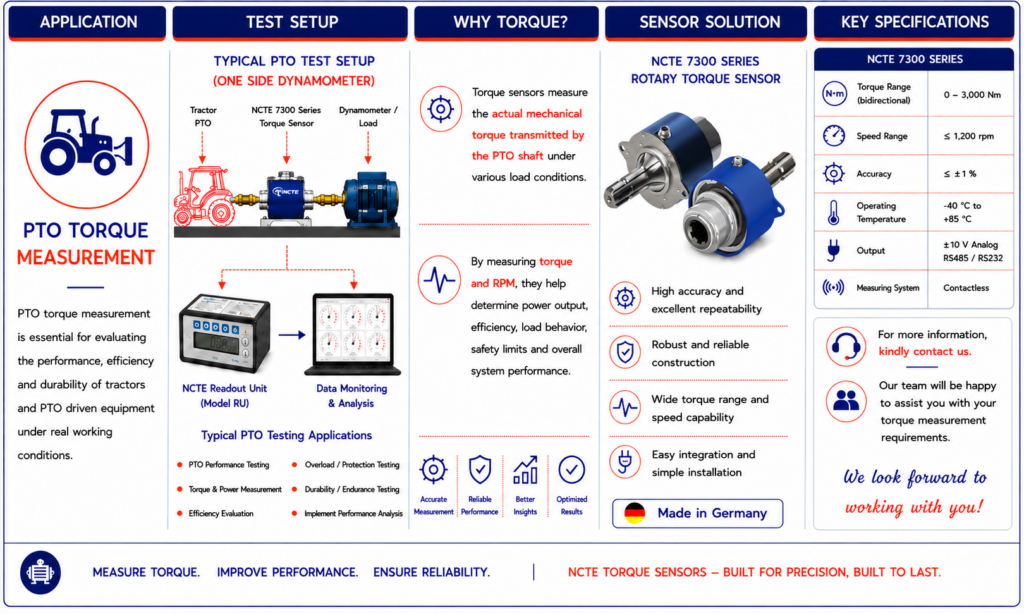
2. PTO Torque Measurement
PTO torque measurement is used to measure the actual torque transmitted through a Power Take-Off (PTO) shaft in tractors, agricultural machinery, and mobile equipment. A torque sensor installed between the tractor PTO drive and the driven machine measures torque during operation.
Combined with PTO speed (RPM), torque measurement helps evaluate transmitted mechanical power, machine loading, operating efficiency, and performance under different agricultural and field conditions.
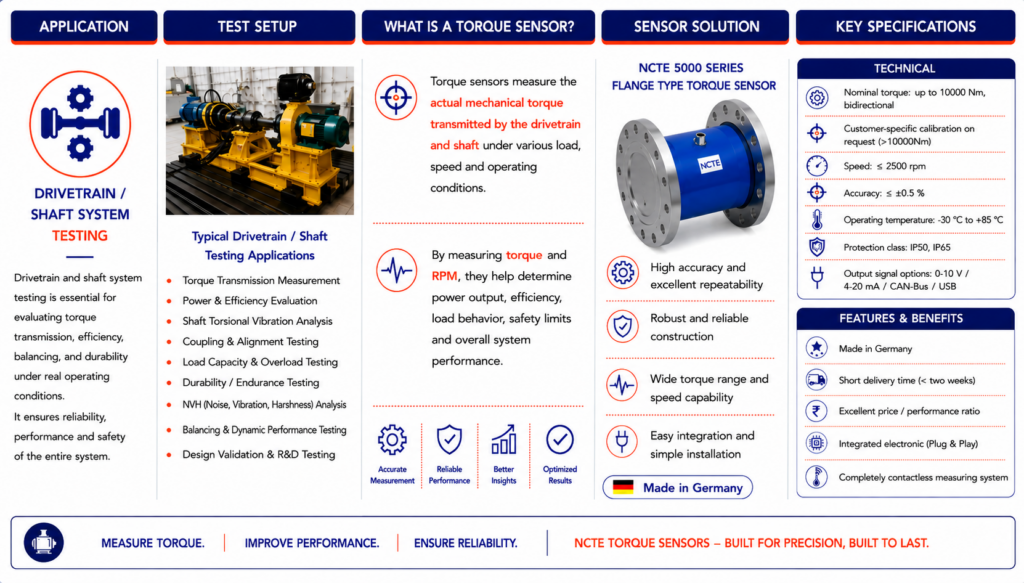
3. Drive Train/Shaft System Testing
Torque measurement is used to evaluate the actual torque transmitted through rotating shafts and drivetrain components in vehicles and industrial machinery. A torque sensor is installed within the drivetrain or shaft system to measure torque under different operating conditions.
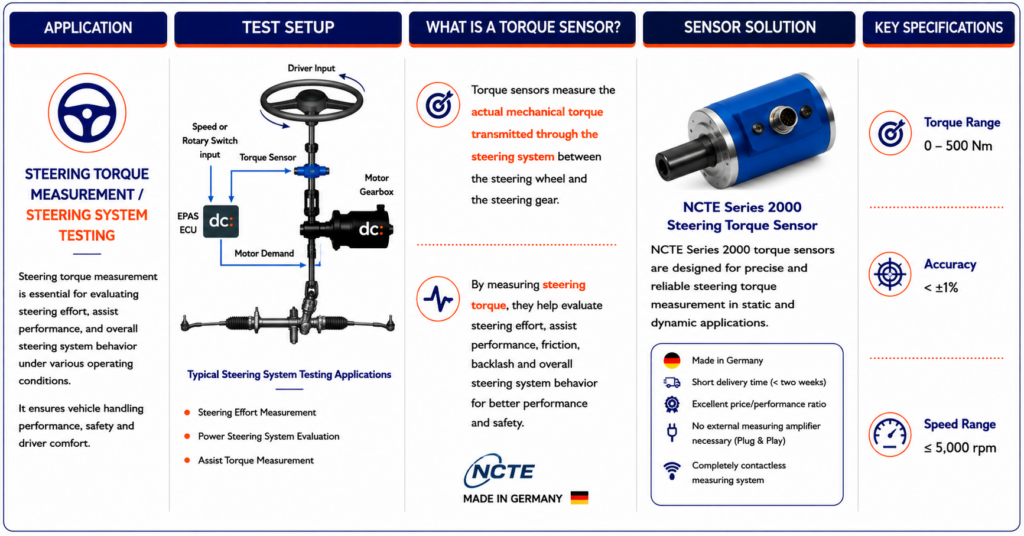
4. Torque Sensors for Steering Applications
Torque sensors for steering applications are used to evaluate the torque required to operate a vehicle steering system and assess steering performance. A torque sensor is installed in the steering test setup to measure torque during different steering conditions.
Depending on the test configuration, the sensor may be used to measure input torque, transmitted torque, or reaction torque
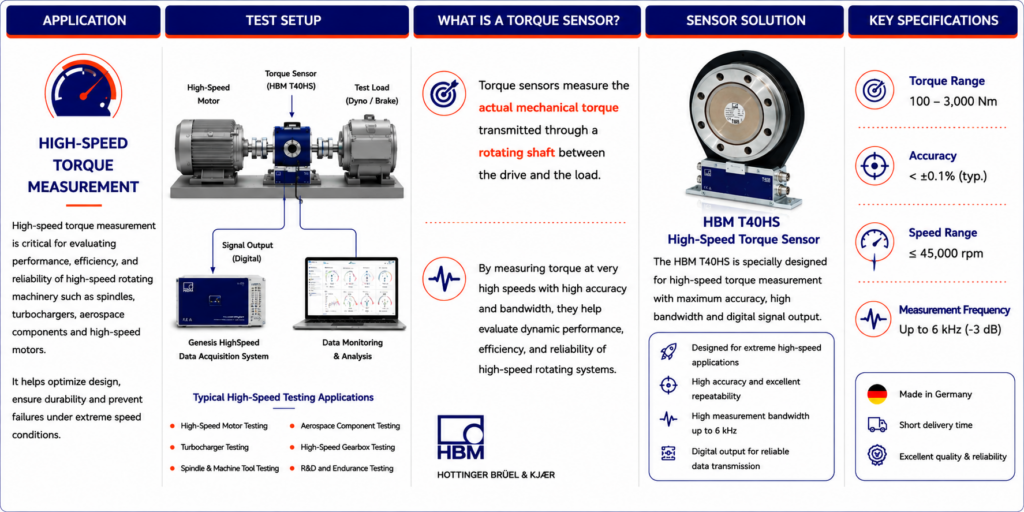
5. High-speed torque measurement
High-speed torque measurement is used to measure dynamic torque on rapidly rotating shafts in motors, turbines, gearboxes, and high-speed drivetrains. A high-speed torque sensor measures torque while the shaft rotates at high RPM.
Combined with speed measurement, torque data helps evaluate:
- Mechanical power
- Motor and drivetrain performance
- Transmission efficiency
- Torque fluctuations
- Dynamic loading
- Rotational stability
- High-speed operating conditions
6. Hydraulic Pump Testing
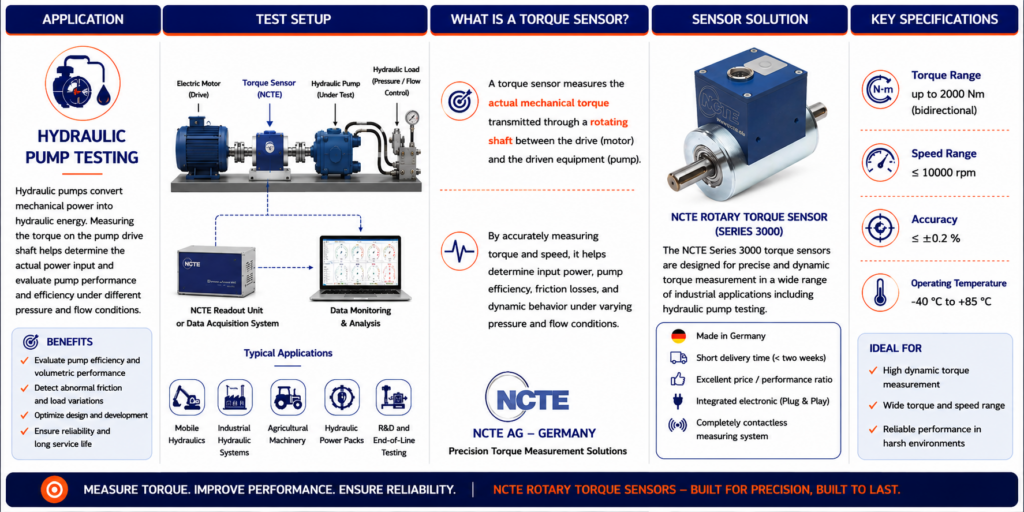
Torque measurement is used to evaluate the shaft torque and mechanical performance of hydraulic pumps, such as gear pumps, axial piston pumps, and vane pumps. A torque sensor is installed between the drive motor and hydraulic pump to measure torque under different operating and load conditions.
7. Hydraulic Motor Testing
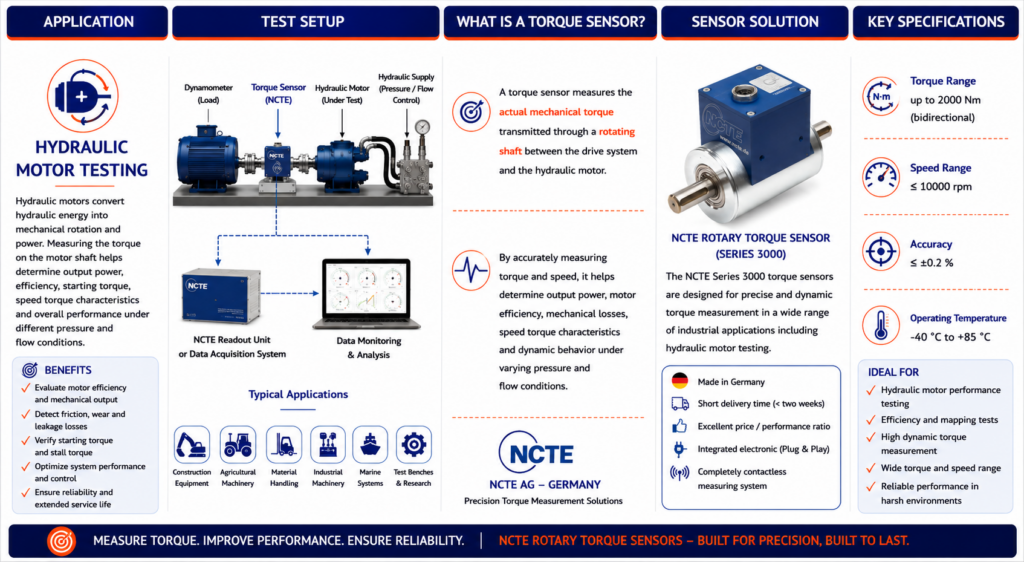
Torque measurement is used to evaluate the shaft torque and mechanical performance of hydraulic motors under different speed, pressure, flow, and load conditions.
8. Compressor Torque Testing
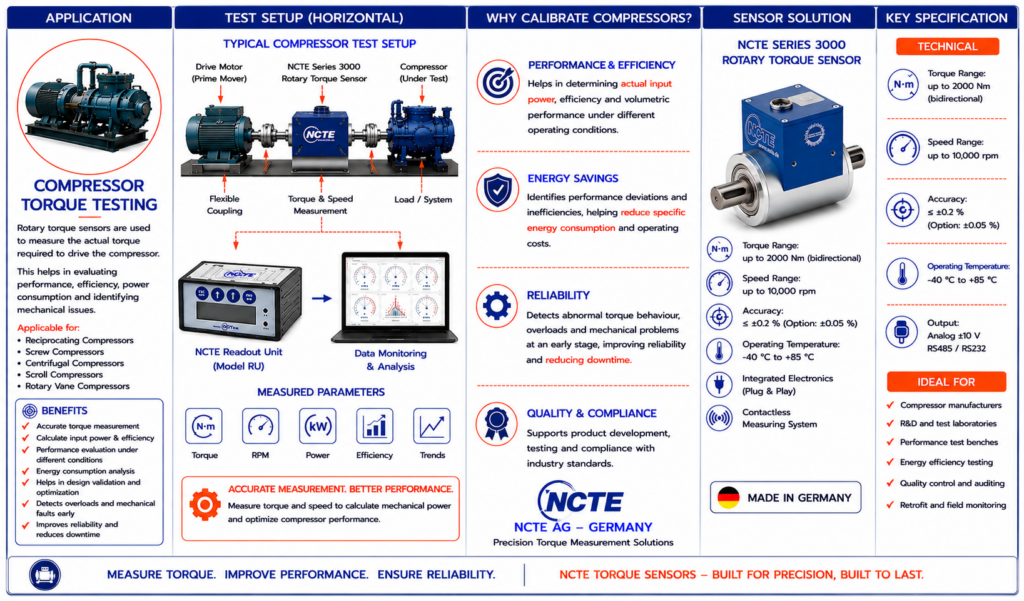
Torque measurement is used to evaluate the shaft torque and mechanical performance of compressors under different operating and load conditions. A torque sensor is installed between the drive motor or engine and compressor to measure the torque transmitted to the compressor..
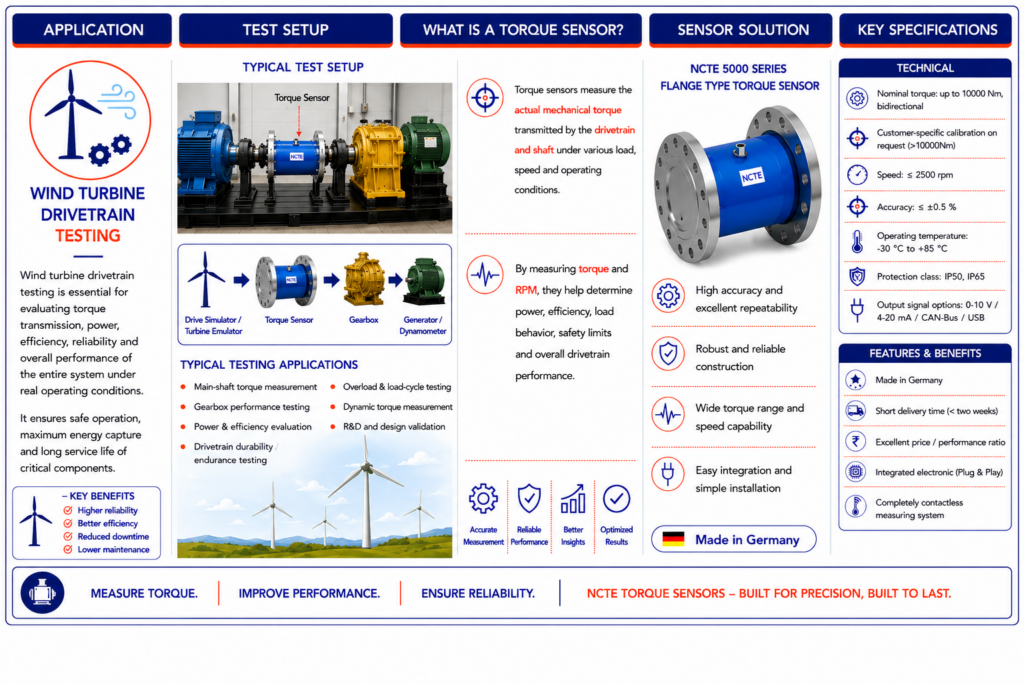
9. Wind turbine drivetrain torque testing
Torque measurement is used to evaluate the mechanical torque transmitted through the wind turbine drivetrain from the rotor to the generator. A torque sensor can be integrated into the drivetrain to measure torque under different wind speeds, loads, and operating conditions.
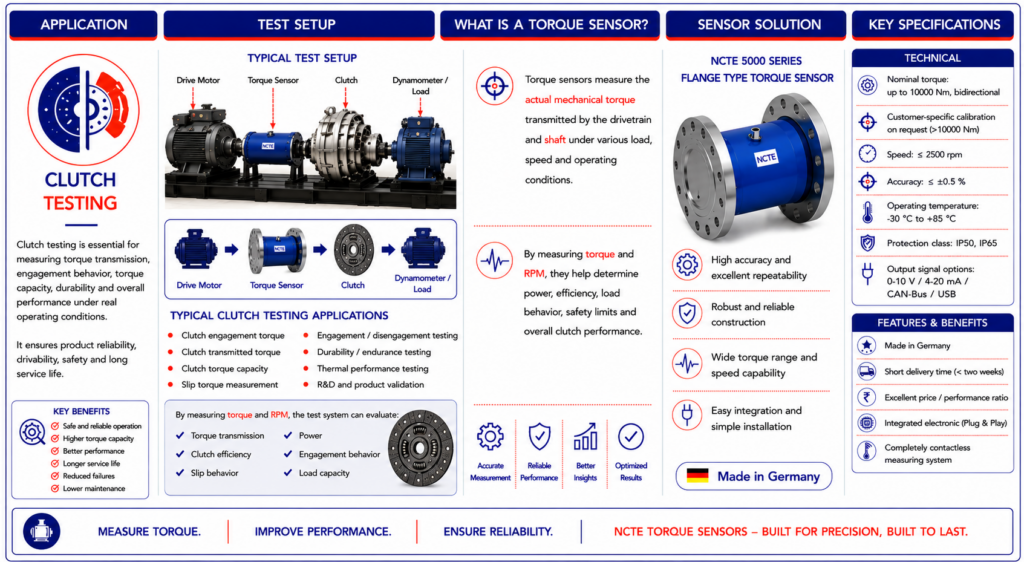
10. Clutch Torque Testing
Clutch torque testing measures the torque transmitted through a clutch during engagement, disengagement, and slip conditions. A torque sensor is installed in the test setup to measure input and transmitted torque under different operating conditions.
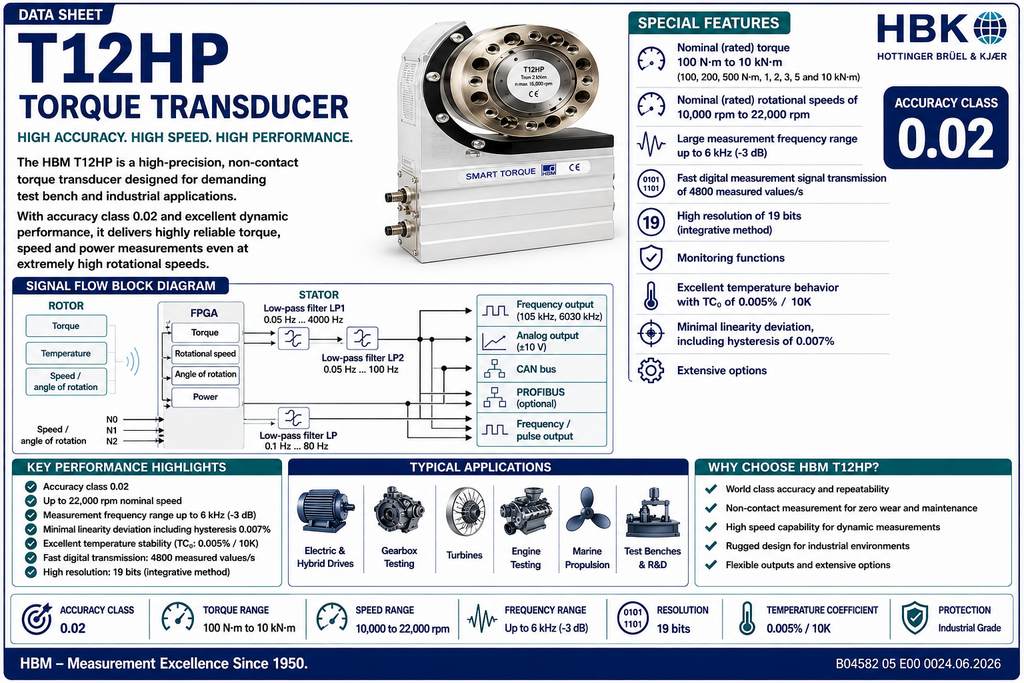
11. High-accuracy torque sensors
High-accuracy torque sensors provide precise measurement of static and dynamic torque for demanding testing and measurement applications. They are suitable for motor testing, gearbox testing, drivetrain testing, calibration, endurance testing, and research applications, where reliable torque data is essential for accurate performance evaluation.
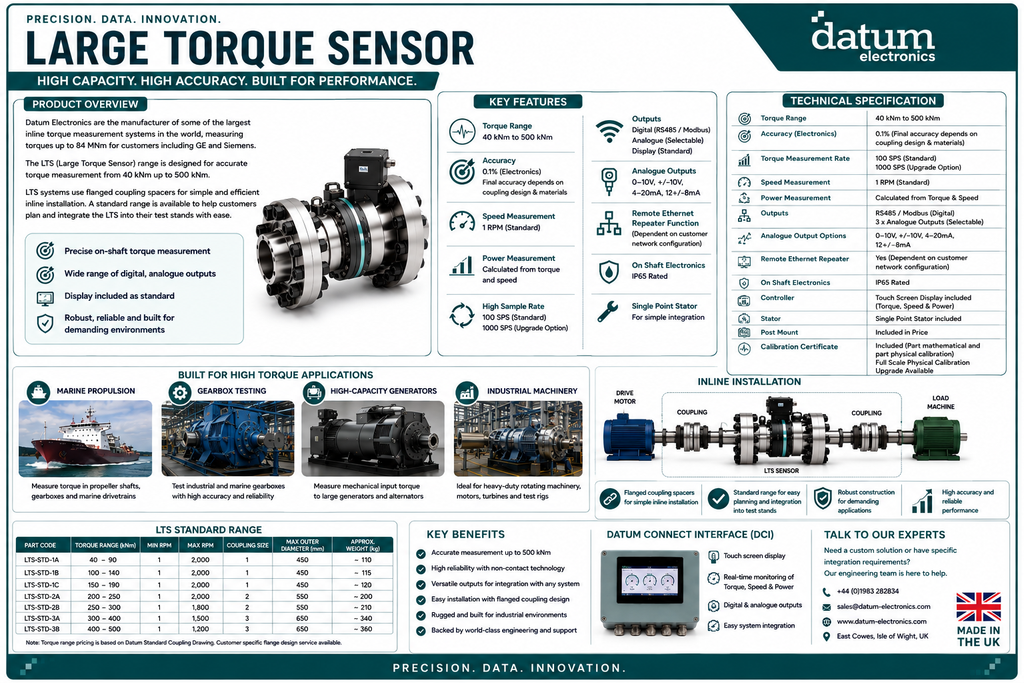
12. High-Capacity Torque Sensors
High-capacity torque sensors are used when the rotating shaft transmits very high mechanical torque. They are particularly useful in marine propulsion, ships, large gearboxes, high-power generators, turbines, and heavy-duty drivetrain testing.
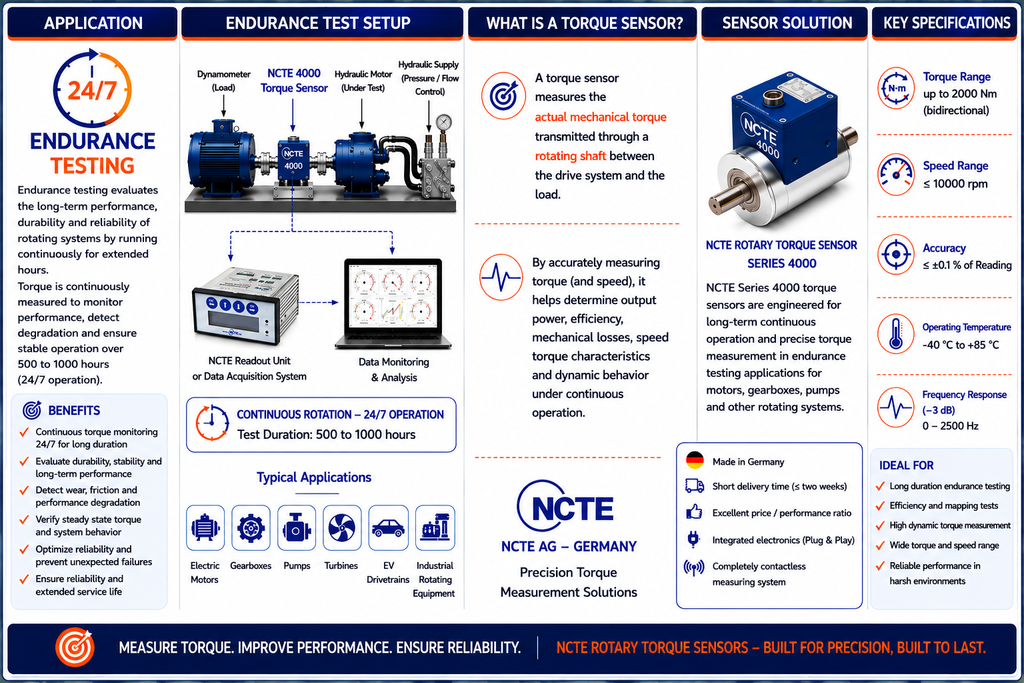
13. Torque sensor for endurance testing
Torque sensors for endurance testing are used to continuously measure and monitor torque during long-duration rotational tests, which may run for several hundred or thousands of hours depending on the test requirement.
They help evaluate durability, wear, stability, and long-term performance of motors, gearboxes, shafts, drivetrains, and other rotating components.
For endurance applications, the sensor should be selected based on:
- Torque range
- Maximum RPM
- Continuous operating capability
- Overload capacity
- Accuracy
- Temperature range
- Long-term measurement stability
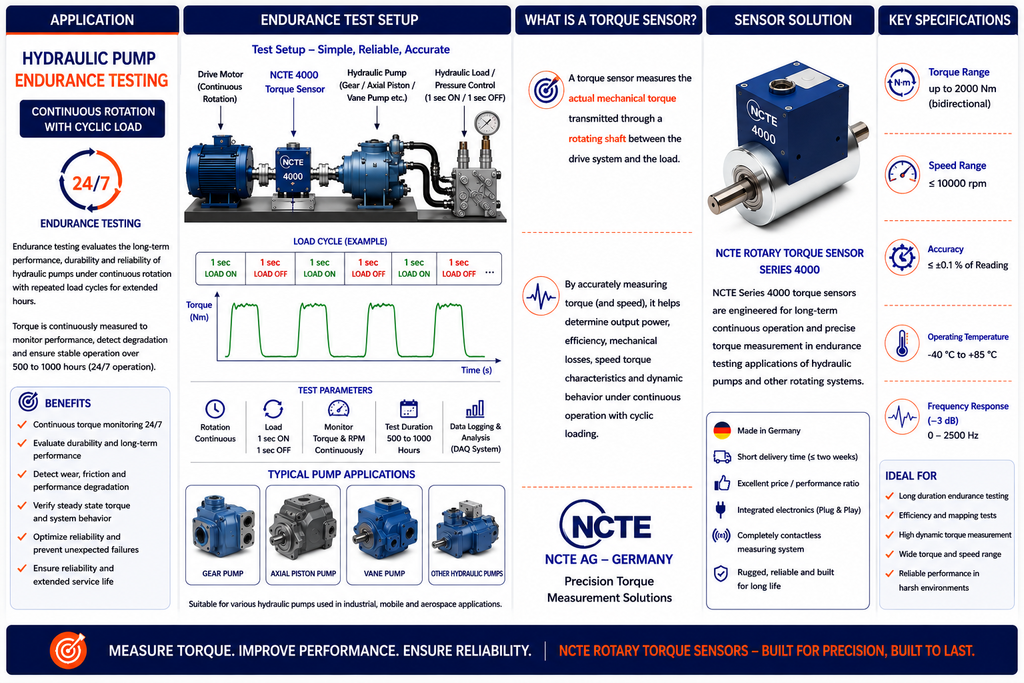
14. Hydraulic pump endurance torque testing
Torque measurement is used for long-duration endurance testing of hydraulic pumps, including gear pumps, axial piston pumps, vane pumps, and other rotating hydraulic machines.
The measurement helps evaluate torque stability, mechanical loading, durability, and performance during extended operating cycles..
15. Torque sensors for fatigue application
Torque sensors for fatigue testing are used to measure repeated and cyclic torque loads applied to shafts, components, drivetrain systems, and mechanical assemblies over a large number of cycles.
For rotating fatigue tests, a rotary dynamic torque sensor is installed in the rotating shaft or drivetrain to measure transmitted torque during repeated loading. For stationary or actuator-driven torsional fatigue tests, a reaction torque sensor may be used to measure the torque resisted by the test specimen or fixed structure.
The suitable sensor depends on the test arrangement, torque range, peak and alternating torque, rotational speed, loading frequency, number of cycles, overload capacity, and required fatigue rating.
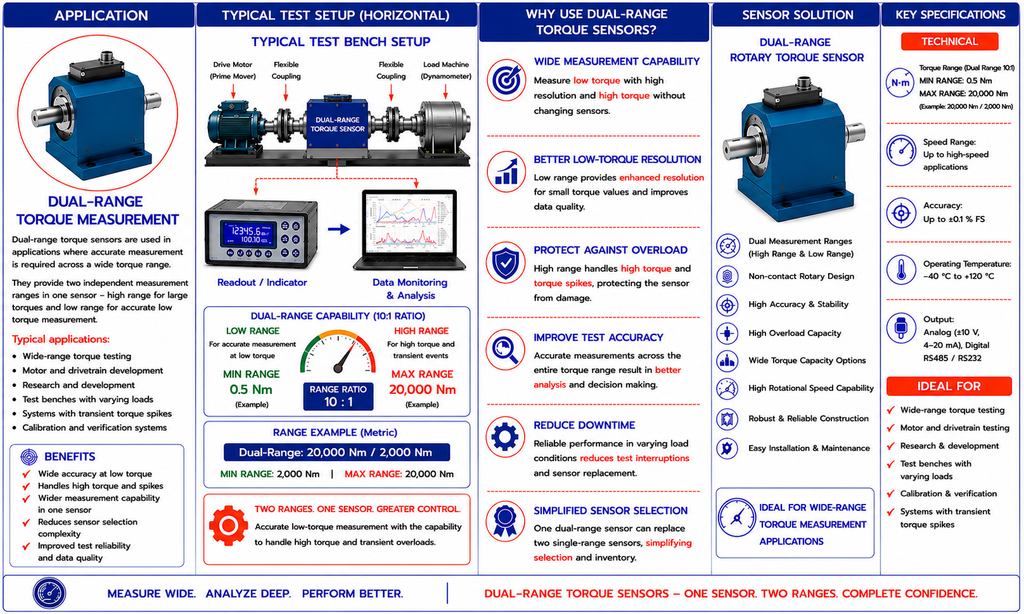
16. Dual-Range Torque Measurement
Dual-range torque measurement is used in applications where accurate measurement is required across a wide torque range. Dual-range torque sensors provide two measurement ranges within a single transducer, allowing improved low-torque resolution while maintaining the capability to measure higher torque loads and transient torque events.
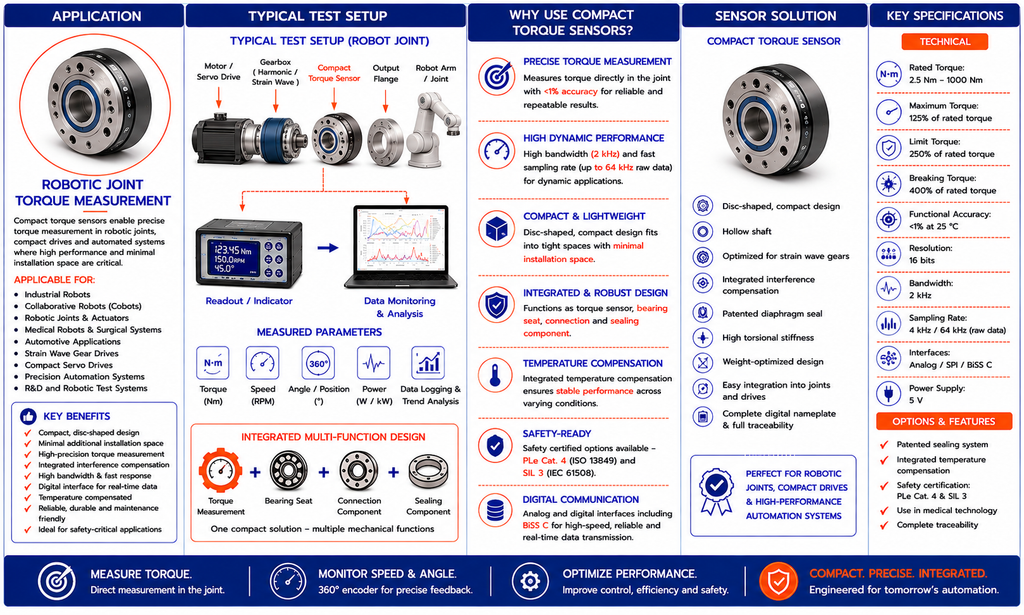
17. Robotic Joint Torque Measurement
Compact torque sensors enable precise torque measurement in robotic joints, compact drives, and automated systems where high measurement performance and minimal installation space are critical. Their integrated design allows torque measurement directly within the mechanical joint or drive while supporting high-speed digital signal transmission.
Couldn’t find a suitable torque sensor for your application?
Get in touch with us. We can help you select the right torque sensor based on your torque range, speed, accuracy, mounting, and application requirements.