
High-Accuracy Multi-Axis Measurement
Chunamur Labs provides multi-axis force & torque sensors for applications where forces and moments need to be measured in multiple directions simultaneously.
Our range includes 2-axis, 3-axis, 5-axis, and 6-axis sensors for robotics, automation, automotive, aerospace, machine testing, material testing, and research applications.
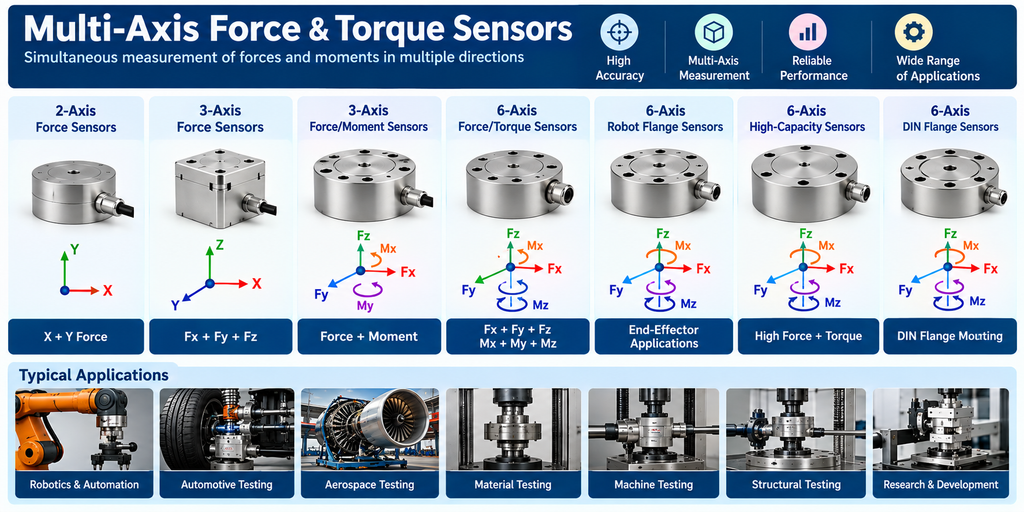
Multi-Axis Sensor Categories
| Sensor Category | Measurement | Typical Applications | View |
|---|---|---|---|
| 2-Axis Force Sensors | X + Y Force | Multi-directional force measurement, machine testing | View |
| 2-Axis Force/Torque Sensors | Force + Torque | Axial/torsional testing, machine testing | View |
| 3-Axis Force Sensors | Fx + Fy + Fz | Robotics, material testing, force measurement | View |
| 3-Axis Force/Moment Sensors | Force + Moment | Machine and structural testing | View |
| 5-Axis Force/Torque Sensors | Multi-axis Force + Torque | Robotics, assembly, and testing | View |
| 6-Axis Force/Torque Sensors | Fx + Fy + Fz + Mx + My + Mz | Robotics, automation, and research | View |
| 6-Axis Robot Flange Sensors | 3 Forces + 3 Moments | Robot end-effectors and force control | View |
| 6-Axis High-Capacity Sensors | High Force + Moment | Automotive, aerospace, and structural testing | View |
| 6-Axis DIN Flange Sensors | 3 Forces + 3 Moments | Industrial machines and test systems | View |
What Are Multi-Axis Sensors?
Multi-axis sensors measure force, torque and/or moment components in multiple directions using a single sensing assembly. They are suitable for applications where loading can occur simultaneously along different axes.
A 6-axis sensor can measure:
- Fx – Force along X-axis
- Fy – Force along Y-axis
- Fz – Force along Z-axis
- Mx – Moment about X-axis
- My – Moment about Y-axis
- Mz – Moment about Z-axis
Key Specifications
When selecting a multi-axis sensor, important parameters include:
- Number of axes
- Force capacity
- Torque/moment capacity
- Sensitivity
- Resolution
- Non-linearity
- Hysteresis
- Repeatability
- Cross-talk
- Overload capacity
- Frequency response
- Operating temperature
- Mounting configuration
- Output and signal conditioning
Cross-Talk
Cross-talk is an important consideration in multi-axis measurement. It refers to unwanted output on one measurement axis when force or moment is applied to another axis.
For high-accuracy applications, sensor calibration and cross-talk compensation are important for obtaining reliable multi-axis measurements.
Applications
Multi-axis force and torque sensors are suitable for:
- Robotics and automation
- Robot end-effectors
- Automotive testing
- Aerospace testing
- Assembly force monitoring
- Machine testing
- Material testing
- Structural testing
- Grinding and polishing
- Force-controlled applications
- Research and development
- Test benches
How to Select the Right Sensor
The appropriate multi-axis sensor depends on the application and measurement requirements. Consider:
Number of axes | Force range | Moment/torque range | Accuracy | Cross-talk | Mounting | Temperature | Output | DAQ compatibility
Share your application details and required force and moment ranges with us, and we can help identify a suitable sensor configuration.
Multi-Axis Sensor Solutions
Whether you require a 2-axis force sensor, 2-axis force/torque sensor, 3-axis force sensor, or 6-axis force/torque sensor, Chunamur Labs can support you with suitable measurement solutions based on your application requirements.
Looking for a suitable multi-axis force or torque sensor?
Contact Chunamur Labs with your application, required capacity, mounting details, and measurement requirements. Our team will help you identify a suitable solution for your testing and measurement application.