
Precision Force Measurement in Confined Spaces
Chunamur Labs supplies button-type compression load cells designed for customers who require accurate force measurement in limited or confined spaces. Their compact construction makes them suitable for applications where reliable compression measurement is required within a small installation area.
These load cells are available in different sizes and force capacities to meet a wide range of testing, industrial, and precision measurement requirements.
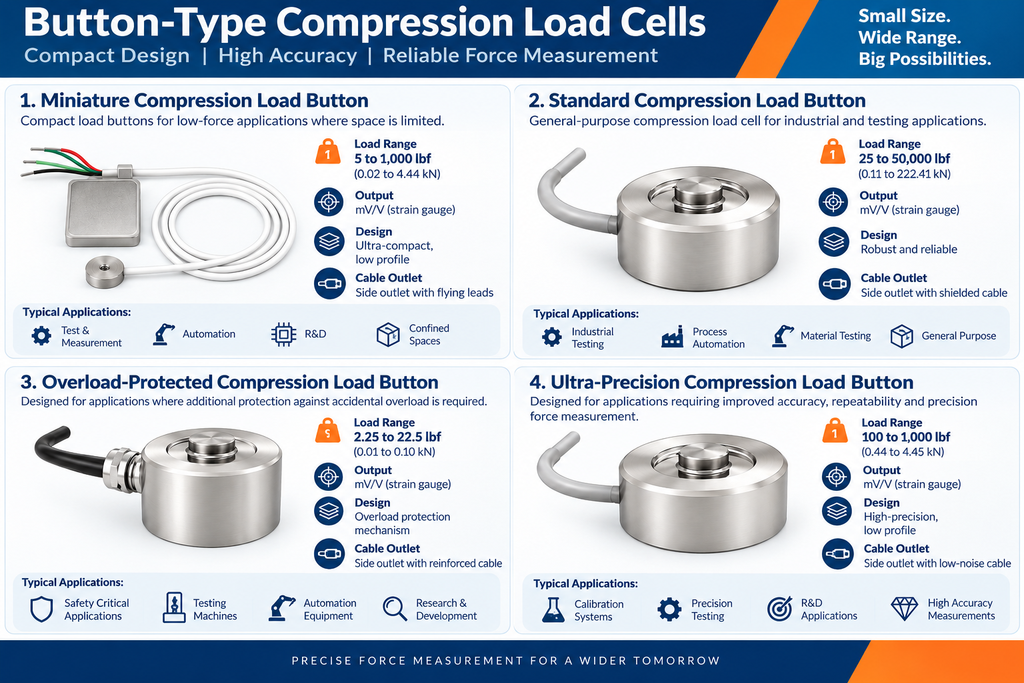
Key Features
- Compact design for confined spaces
- Accurate compression force measurement
- Suitable for low- to high-force applications
- Spherical loading surface to help manage misaligned loads
- Designed for measurement along the primary sensing axis
- Available in miniature and standard configurations
- Suitable for industrial testing and research applications
- Different accuracy and overload-protection options
Spherical Loading Design
The shaped loading button incorporates a spherical radius to help maintain the applied force close to the primary sensing axis, even when minor misalignment occurs.
This design helps reduce unwanted bending moments and improves the reliability of compression force measurement.
The correct loading radius and contact surface are important for maintaining accurate measurement and preventing excessive stress at the contact point.
Compression Loading Guidelines
Proper loading is essential when using button-type compression load cells.
Recommended Practices
- Always apply the load along the primary axis.
- Use a suitable loading plate or bearing surface.
- Ensure the loading surfaces are clean, flat and properly finished.
- Avoid applying a flat plate directly against the top of the load button.
- Avoid side loads, eccentric loads and bending moments.
- Use the correct spherical radius for the loading arrangement.
- Prevent shock loading unless the sensor is designed for dynamic applications.
- Follow the manufacturer’s recommended loading conditions.
Why Flat-to-Flat Loading Should Be Avoided
Applying a compression load flat-to-flat between a plate and the top of a load button can create an uneven contact point. Even a small misalignment may shift the load away from the centerline and introduce an unwanted moment into the measurement.
A suitable spherical loading arrangement helps accommodate minor misalignment and keeps the applied force closer to the primary sensing axis.
An unsuitable radius or rough contact surface may cause:
- Excessive contact stress
- Material indentation
- Surface wear
- Galling
- Measurement errors
- Damage to the load cell or loading plate
Available Button-Type Compression Load Cells
| Product Type | Description | Load Capacity | Equivalent Range |
|---|---|---|---|
| ConvexBT Miniature Compression Load Button | Compact load button designed for confined-space applications and improved resistance to eccentric or misaligned loading. | 5 to 1,000 lbf | 0.02 to 4.45 kN |
| LBM Compression Load Button | Compact stainless-steel compression load button for general force measurement applications. | 25 to 50,000 lbf | 0.11 to 222.41 kN |
| LBMP Overload-Protected Compression Load Button | Compression load button designed with overload protection for applications requiring additional protection against accidental overload. | 2.25 to 22,500 lbf | 0.01 to 100 kN |
| LBMU Ultra-Precision Compression Load Button | High-performance compression load button designed for improved precision and repeatability. | 100 to 1,000 lbf | 0.45 to 4.45 kN |
Note: Exact load capacity and performance specifications depend on the selected model. Please verify the final specifications with the manufacturer’s datasheet.
Typical Applications
Button-type compression load cells are suitable for:
- Compression testing machines
- Force testing fixtures
- Assembly force measurement
- Press force measurement
- Connector testing
- Switch and button testing
- Spring testing
- Robotics and automation
- Medical instruments
- Laboratory equipment
- Component validation
- Research and development
- Quality control
- Small-area force measurement
Example Performance Specifications
Depending on the selected model, specifications may include:
| Parameter | Example Specification |
|---|---|
| Rated Output | Approximately 2.00 ± 20% mV/V |
| Nonlinearity | Approximately ±0.25% of full scale |
| Hysteresis | Approximately ±0.25% of full scale |
| Static Error Band | Approximately ±0.50% of full scale |
| Material | 17-4 PH heat-treated stainless steel, model-dependent |
| Temperature Compensation | Model-dependent |
| Operating Temperature | Model-dependent |
Important: These values are example specifications from the referenced product information and must be confirmed against the final selected model before quotation or publication.
Selection Parameters
When selecting a button-type compression load cell, consider:
- Required force capacity
- Required accuracy
- Available installation space
- Load button diameter
- Sensor height
- Loading plate design
- Required spherical radius
- Overload protection
- Operating temperature
- Indicator or DAQ compatibility
Why Choose Chunamur Labs?
Chunamur Labs supports customers in selecting suitable force measurement solutions based on application requirements.
Our support includes:
- Force range selection
- Accuracy evaluation
- Mechanical loading guidance
- Indicator and DAQ integration
- Calibration support
- Test and validation support
- Application-specific force measurement solutions
Contact Chunamur Labs.
Looking for a compact and precise compression force sensor?
Contact Chunamur Labs for button-type compression load cells that meet your required force range, accuracy, and installation space.